
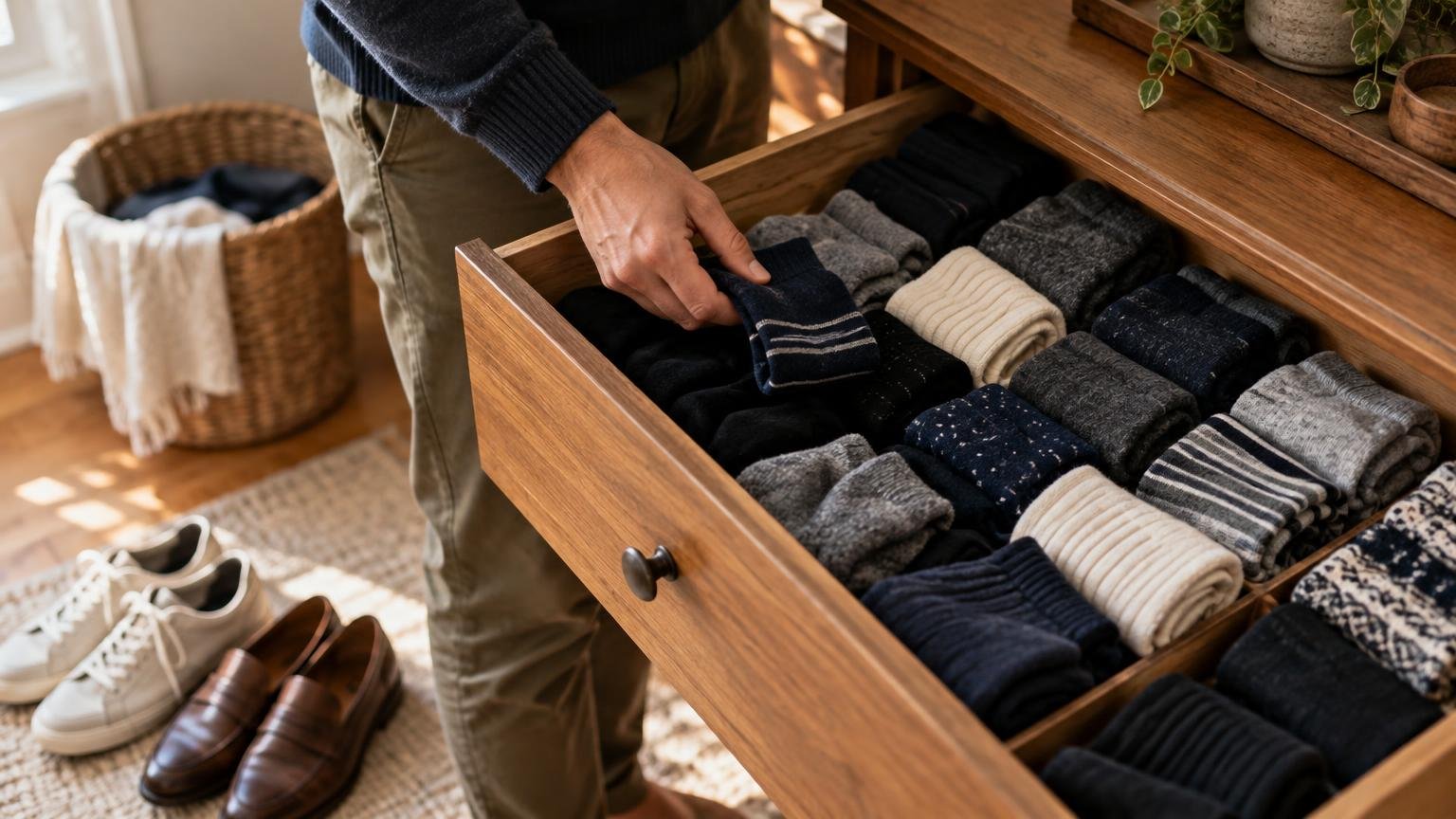
TLDR: If you are wondering how many pairs of everyday socks do you actually need, start with 10–14 wearable pairs. That is enough for a typical weekly laundry routine, a few delayed wash days, and an occasional change into a fresh pair. Choose 7–10 only if you manage laundry closely; consider 16–20 if you wash socks every other week or regularly need extras.
The most useful answer is not a minimalist magic number. It is a small, outfit-ready rotation based on how often you wash socks, how many pairs you use in a day, and which shoes you actually wear. For most people, 10–14 everyday pairs offer the best balance: enough breathing room without filling a drawer with pairs that never leave it.
How many pairs of everyday socks do you actually need?
| Your routine | Useful starting count | Why it works |
|---|---|---|
| Laundry more than once a week | 7–10 pairs | Enough for a tightly managed rotation with a small backup. |
| Laundry about once a week | 10–14 pairs | Covers the week, several backups, and minor laundry delays. |
| Laundry about every other week | 16–20 pairs | Provides a clean pair for most days plus a modest buffer. |
| Frequent workouts or physical work | 10–14 everyday pairs, plus activity-specific pairs | Keeps sweaty or specialized socks from consuming the everyday rotation. |
These ranges are wardrobe-planning recommendations, not a medical or fashion standard. Your ideal number could be lower if you wear sandals several days a week or higher if you change socks during the day.
A simple calculation is: count the days between sock-laundry loads, then add two to four backup pairs. If socks are washed every seven days, that produces a baseline of 9–11 pairs. Moving closer to 12–14 gives you more room for a missed laundry day, wet weather, travel, or the pair hiding inside a fitted sheet.
Count everyday socks separately from specialist pairs
Everyday socks are the pairs you reach for with your normal shoes and routine outfits. Depending on your wardrobe, that might mean casual crew socks, ankle socks, fine-gauge work socks, or a combination of those styles.
Workout, running, hiking, ski, compression, and formal occasion socks do not need to inflate the everyday total. Give those categories their own small rotations based on how often you use them. Someone who runs four times a week might own 10–12 everyday pairs and four or five running pairs rather than trying to make every sock serve both jobs.
This separation also prevents a misleading drawer count. Twenty pairs may sound generous, but not if six are hiking socks, four only work with dress shoes, and three are uncomfortable enough that you avoid them. Count only matching, comfortable pairs that suit your regular shoes.
Build the count around laundry, sweat, and weather
Clean-sock availability matters more than the total number you purchased. The American Cleaning Institute recommends washing socks after each wear. The American Academy of Dermatology advises changing them daily and changing more often when socks become wet or sweaty.
The practical consequence is straightforward: do not plan on extending a small rotation by repeatedly wearing the same unwashed pair. If you often exercise at lunch, work outdoors, commute in hot weather, or get caught in the rain, keep enough extras to change when needed. The CDC’s foot-hygiene guidance likewise advises changing socks at least daily and keeping feet clean and dry.
Add three to five activity-specific pairs if extra changes are common several days a week. If they happen only occasionally, two spare everyday pairs may be sufficient. You can also keep one clean pair in a gym bag or work bag rather than expanding the entire drawer.
Choose a mix that works with your shoes
A good quantity is only useful when the sock heights and colors match your wardrobe. Start by looking at the shoes worn during an ordinary two-week period, not every shoe you own.
| Common shoe or outfit | Practical sock choice | How many within a 10–14 pair rotation |
|---|---|---|
| Casual sneakers | Crew or ankle socks in your most-used neutral | 5–8 pairs if sneakers dominate your week |
| Boots or high-top shoes | Crew socks that extend comfortably above the collar | 2–4 pairs if worn regularly |
| Office shoes or smart trousers | Darker, finer crews or trouser socks | 3–5 pairs for a typical workweek |
| Loafers or low-cut shoes | No-show socks, when that is the look and fit you prefer | 2–3 pairs if these shoes appear often |
Treat those numbers as examples rather than categories to collect. A sneakers-only wardrobe may need ten similar crew pairs and nothing else. Someone splitting the week between an office and casual weekends might prefer six dark work pairs, five casual pairs, and two no-show pairs.
Color can make a modest rotation feel much easier. Pick one main neutral that works with most trousers and shoes, then add a second neutral or a few patterned pairs. Black, navy, charcoal, white, cream, and brown can all work; the best base is the one already repeated in your wardrobe. Buying several compatible pairs also makes laundry matching simpler.
When 10 pairs are enough—and when they are not
Ten pairs are enough for many people who wash laundry weekly and use roughly one pair per day. The rotation becomes less comfortable when laundry is frequently delayed, several pairs are reserved for particular shoes, or workouts require a second clean pair.
- Stay near 7–10 pairs if you wash socks more than once a week, wear open shoes regularly, and rarely need a mid-day change.
- Choose 10–14 pairs for a normal weekly laundry schedule and a useful backup margin.
- Choose 16–20 pairs if sock laundry happens every other week, you travel often, or you want a larger buffer.
- Add a separate activity rotation if you train, hike, or perform physical work several times per week.
More is not automatically more convenient. An overfilled drawer can hide the pairs you like and preserve uncomfortable socks long after they should have left the rotation. Once you have enough clean options to cover your routine, improving the mix is usually more useful than increasing the number.
Use a simple travel rule
For a short trip without planned laundry, pack one pair for each day plus one or two spares. A seven-day trip therefore calls for eight or nine pairs. Add another pair if the itinerary includes a workout, a wet-weather day, or an outfit that needs a different sock style.
For longer trips with laundry access, pack for the number of days between washes rather than the full journey. Five to seven everyday pairs plus specialist socks may be enough when you know you can wash them. Check the forecast and planned shoes before adding more; a second sock height is useful only if a shoe or activity calls for it.
Reset your sock drawer before buying more
Your current drawer may already contain the right number of socks but the wrong number of usable pairs. A quick reset gives you a more honest count.
- Gather socks from the drawer, hamper, gym bag, suitcase, and shoe storage.
- Match complete pairs and count only the ones you willingly wear.
- Remove pairs with holes, badly stretched cuffs, persistent discomfort, or thinning areas that no longer feel protective.
- Sort the remaining pairs by purpose: everyday, exercise, outdoor, work or formal, and special-use.
- Compare the everyday total with the number of days between laundry loads.
- Fill genuine gaps with one or two versatile colors and the heights required by your regular shoes.
There is no reliable universal replacement schedule in months or wears. Replace a pair when its condition or fit stops serving you: holes, slipping heels, stretched cuffs, uncomfortable seams, or noticeably thin areas are more useful signals than the calendar.
Care for the rotation you keep
Wash socks after wearing them and follow the care directions supplied with the product. Hosiery instructions may appear on packaging or another conspicuous location rather than on a permanently attached label, so check the packaging before discarding it if the sock itself has no care label.
Avoid assuming that every sock containing a particular synthetic fiber automatically manages moisture well. The American Academy of Dermatology notes that fiber content alone does not establish whether clothing will wick moisture. Fit, construction, thickness, shoe choice, and the finished fabric all affect how a pair feels in use.
The practical answer
Start with 10–14 pairs of everyday socks, then adjust the number to your real laundry interval. Keep workout and specialist socks in separate mini-rotations, and build the everyday mix around the shoes and colors you wear most.
The easiest next step is to count your wearable everyday pairs today. If you can cover every day between washes plus two to four backups, you have enough. If not, buy only the missing style or color rather than rebuilding the whole drawer.
References
- Do I need to wash this? | The American Cleaning Institute (ACI)
- How to prevent athlete's foot
- Healthy Habits: Foot Hygiene | Water, Sanitation, and Environmentally Related Hygiene (WASH) | CDC
- Clothes Captioning: Complying with the Care Labeling Rule | Federal Trade Commission
- Care Labeling of Textile Wearing Apparel & Certain Piece Goods | Federal Trade Commission
- Hyperhidrosis: 6 tips dermatologists give their patients