
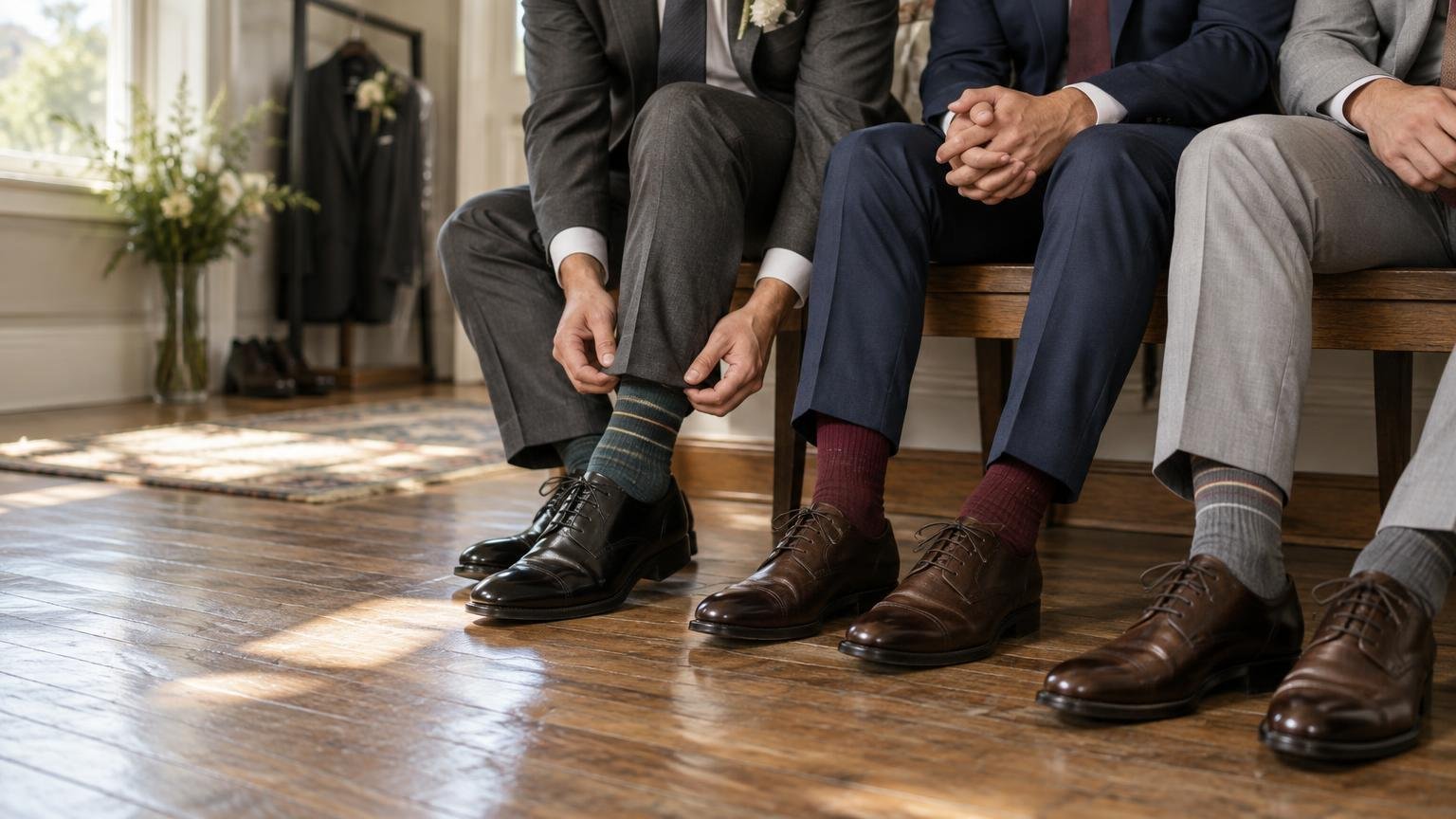
TLDR: For most wedding-party members wearing suits or tuxedos, choose thin dress socks that reach at least mid-calf and roughly match the trousers. Black over-the-calf socks are the conventional choice for black tie. At less formal weddings, a restrained color, small pattern or personalized design can work if it coordinates with the palette and has the couple’s approval.
The best sock styles for wedding parties begin with the outfit, not the novelty design. Formality, trouser color and footwear should settle the basic choice. Color and personality come afterward. This keeps a coordinated group looking intentional while still leaving room for a small shared detail.
This advice applies most directly to wedding-party members in tailored trousers and dress shoes. If someone is wearing a dress, jumpsuit, kilt, boots, sandals or another outfit, socks may be concealed, optional or governed by a different tradition. Coordinate the visible result rather than forcing every person into an identical sock.
The best sock styles for wedding parties by dress code
| Wedding style | Reliable sock choice | Room for personality |
|---|---|---|
| Black tie | Black, dress-weight, over-the-calf socks | Very little; use a solid or an exceptionally subtle texture |
| Formal suit | Mid-calf or over-the-calf socks close to the trouser color | A fine rib, tonal texture or discreet micro-pattern |
| Semi-formal | Dress socks related to the trousers or wedding palette | Small dots, narrow stripes or a controlled accent color |
| Relaxed or creative | Coordinated dress socks chosen around the full outfit | Bolder colors, motifs or personalized designs with approval |
Black tie: keep the socks quiet
For a conventional black-tie outfit, choose black over-the-calf dress socks. The goal is an uninterrupted line from the black trousers to the formal shoes, including when the wearer sits down. Emily Post includes black dress socks in its black-tie attire guidance.
This is not the occasion to match bright socks to a bouquet or pocket square unless the couple has deliberately reinterpreted the dress code. A fine rib or understated texture can add interest without turning the ankle into the focal point.
Formal suits: follow the trousers
With navy, charcoal, medium-gray or brown tailoring, start with socks in the same general color family as the trousers. They do not need to be an exact fabric match. Navy trousers can take navy or deep blue socks; charcoal trousers work with charcoal or another dark gray. GQ presents matching socks roughly to the trouser hue as a useful dress-sock convention rather than an absolute rule.
Matching the trousers creates visual continuity and is especially helpful when several wedding-party members have slightly different shoes. It also avoids the awkward effect of a contrasting band appearing between the trouser hem and shoe every time someone sits.
Semi-formal and relaxed weddings: introduce one shared idea
Less formal celebrations allow more flexibility. The wedding party might share one deep accent color, the same narrow stripe or a related family of patterns. Wedding-party examples collected by The Knot include neutral dress socks, coordinated colors and playful or personalized options.
The cleanest approach is to repeat one element rather than everything. For example, everyone could wear different navy-based patterns, or the group could use one burgundy accent across several sock designs. This is the same principle used when coordinating socks without making everyone identical: a shared color or motif creates unity while accommodating different preferences and sizes.
Choose sock height before color or pattern
Mid-calf is a practical minimum with most tailored trousers, while over-the-calf is the more dependable formal choice. GQ’s dress-sock guidance describes mid-calf as the minimum proper dress-sock height and over-the-calf as the option more likely to prevent exposed skin when trousers rise in a seated position.
Over-the-calf socks make particular sense for tuxedos, slim or shorter trouser hems, ceremonies with extended sitting and formal group photographs. They also reduce the need to keep pulling socks upward. Mid-calf socks remain suitable for many formal and semi-formal suits, provided the cuff stays up and covers the leg when seated.
An easy fitting check is to sit in a chair while wearing the actual trousers and shoes. If bare leg appears, choose a taller sock. Do this before the wedding rather than discovering the gap during the ceremony.
When no-show socks can work
No-show socks are an intentional styling option for certain loafers and relaxed, ankle-baring outfits, not the default for a traditional suit or tuxedo. GQ treats them as one possible loafer-sock approach, alongside visible socks.
Use no-shows only when the whole outfit is meant to look sockless: loafers, cropped or lightly tailored trousers and a clearly relaxed dress code. They are a poor fit for conventional black tie, and inconsistent coverage can make a coordinated wedding party look accidental. Check that the sock remains fully hidden while walking and sitting.
Use a simple color hierarchy
When several colors could work, make the decision in this order:
- Honor the dress code. Black tie calls for black dress socks in its conventional form.
- Relate the socks to the trousers. This produces the smoothest and most versatile line.
- Use the wedding palette as an accent. Choose a deeper or more muted version if the main palette is very bright.
- Consider the shoes and other accessories. The socks should connect the outfit, not compete with every detail.
- Add personality only after the first four choices look coherent.
Socks do not generally need to match the tie, bow tie or pocket square exactly. Exact matches can look overly packaged, particularly when the color is bright. A tonal relationship is easier: dusty-blue accessories with navy socks, for example, or rust accents with dark brown socks.
If the wedding party is wearing mixed trouser colors, prioritize coordination rather than identical socks. Charcoal and navy suits might each get matching dark socks with the same small burgundy dot. The shared pattern ties the group together, while the base color still works with each outfit.
Keep patterns proportional to the occasion
A sock pattern is most successful when it feels like a detail discovered up close rather than the first thing visible across the room. The more formal the wedding, the smaller and quieter the pattern should be.
- Solid colors: the safest choice for black tie, formal ceremonies and mixed personal styles.
- Fine ribs and tonal textures: add depth without reading as a strong pattern.
- Micro-dots, small geometrics and narrow stripes: useful for formal or semi-formal suits when the colors remain controlled.
- Bold stripes, bright motifs and novelty designs: better for relaxed celebrations, private getting-ready photos or a deliberate theme.
- Names, faces, dates and inside jokes: suitable only when the couple wants a personalized element and every wearer is comfortable with it.
If novelty socks are part of the plan but the ceremony is formal, consider using them for getting-ready photographs and changing into solid dress socks before the ceremony. Another option is to reserve the playful pair as a gift rather than requiring it as part of the outfit.
Plan for comfort without guessing from one fiber name
Wedding socks have to survive more than the ceremony. There may be hours of standing, walking, photographs and dancing, so fit and construction matter as much as appearance.
Look for a smooth dress-weight sock that fits comfortably inside the chosen shoe. A thick casual sock can crowd a closely fitted dress shoe, while a poorly fitted thin sock may bunch under the foot. Check the toe seam, cuff and heel placement during a full outfit fitting.
Read the composition label rather than relying only on broad marketing terms. Federal textile-labeling rules generally require covered textile products to disclose their fiber content by percentage by weight, giving shoppers a consistent starting point for comparison. The label will not reveal everything about comfort or durability, but it helps distinguish socks that merely look similar online.
Stretch fibers are commonly used to support fit, but the full construction still matters. The practical test is whether the sock stays smooth, remains up and fits inside the shoe without pressure. Anyone with known sensitivities or specific comfort needs should review the full label and try the socks before the event.
A group-order checklist that prevents wedding-morning problems
Do not order a single nominal size for the entire wedding party without checking the maker’s size chart. Collect the details first, set one clear visual rule and leave enough time for an outfit fitting.
- Confirm the dress code and whether the couple wants classic, coordinated or playful socks.
- List each wearer’s trouser color, shoe style and shoe color.
- Collect the sizing information required by the specific sock seller.
- Choose mid-calf or over-the-calf as a group unless an outfit requires a different solution.
- Review the stated fiber composition and care instructions.
- Ask whether anyone has a material sensitivity, compression requirement or strong fit preference.
- Have each person try the socks with the actual trousers and shoes while standing, walking and sitting.
- Buy at least one suitable backup pair for the wedding-day kit.
If identical socks are unavailable in every required size, preserve the shared visual feature instead of forcing the same product. Matching base colors with similar small patterns will look more polished than identical socks that sag, pinch or fit poorly.
Three dependable ways to coordinate the group
1. Classic and formal
Give each wearer dress-weight socks close to the trouser color, using black over-the-calf socks for black-tie outfits. This route is the easiest to manage and the least likely to date photographs.
2. Coordinated but not identical
Choose a shared accent, such as burgundy micro-dots, and place it on base colors suited to each outfit. This works well for mixed suits, varied personal styles or groups that need different sock constructions.
3. Personalized and playful
Use motifs, initials or an inside joke for a relaxed wedding or as a getting-ready gift. Keep the colors connected to the day, secure the couple’s approval and provide a quieter ceremony pair if the formal attire calls for one.
The final choice
For the safest all-purpose answer, select thin mid-calf or over-the-calf dress socks in a shade close to the trousers. Choose black over-the-calf socks for conventional black tie. Move toward accent colors and small patterns as the dress code becomes less formal, saving bold novelty designs for celebrations where personality is explicitly part of the plan.
Before ordering for the group, confirm the dress code, trouser colors, footwear, individual sizes and preferred sock height. Then test one complete outfit while sitting as well as standing. If the socks stay up, cover the leg and support the overall look without demanding attention, the small detail is doing its job.
References
- Attire Guide: Dress Codes from Casual to White Tie Formal — Emily Post
- 15 Best Dress Socks for Men 2026: Tried, Tested, and Stylish | GQ
- Matching socks with shoes and slacks | GQ
- 25 Best Groomsmen Socks: Custom & Fun Groomsmen Dress Socks
- The Best Socks for Loafers Will Save Your Sweaty Soles | GQ
- The Textile Products Identification Act | Federal Trade Commission
- www.ftc.gov