
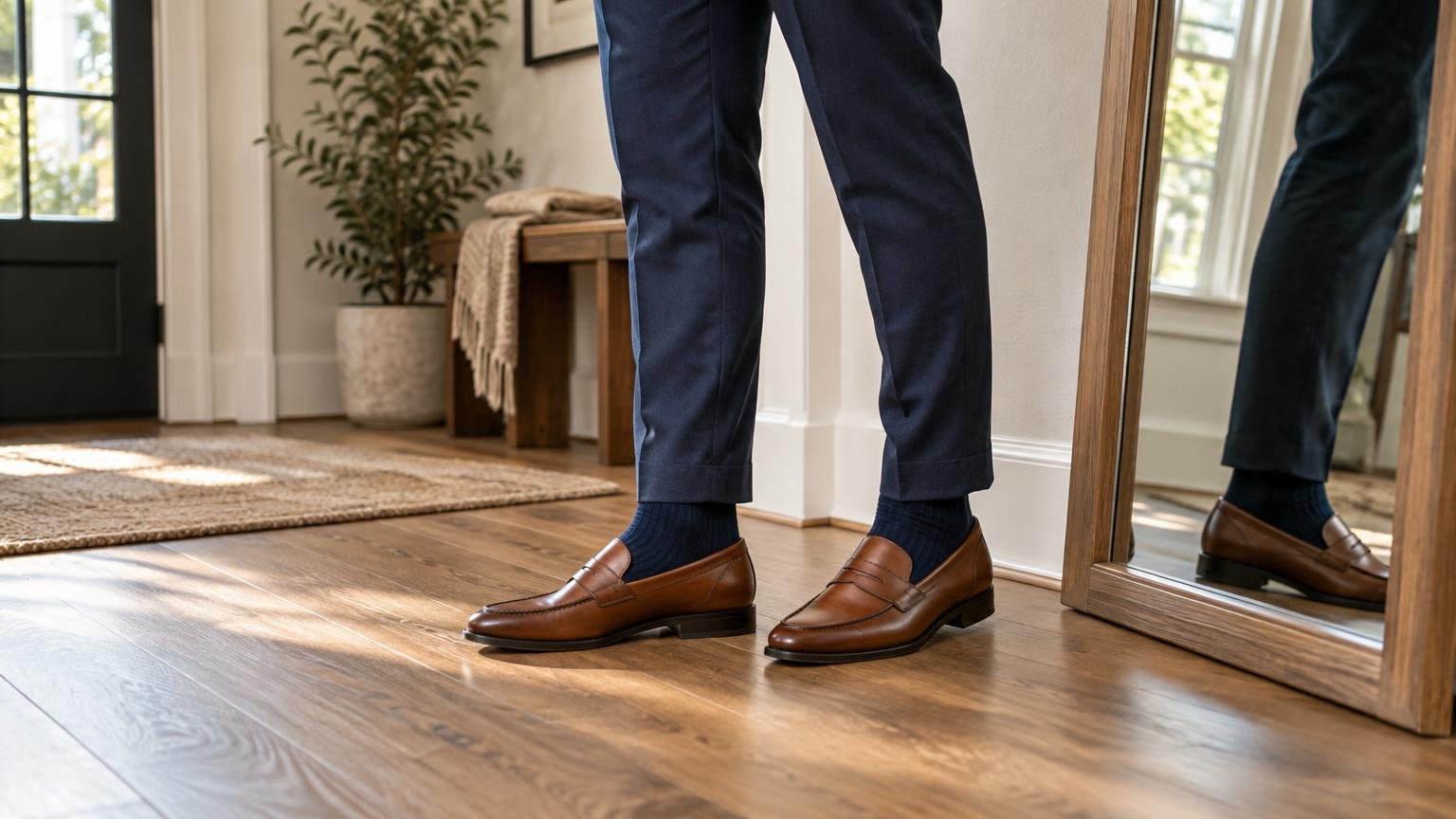
Usually, your socks should coordinate more closely with your pants than with your shoes. If you are wondering should your socks match your pants or your shoes, use the pants-first approach for the easiest polished result—especially with a suit, tailored trousers or business clothes.
This is a flexible styling convention, not an unbreakable dress-code rule. Matching the general color family of your trousers creates a smoother transition down the leg, while the shoes remain a distinct finishing element. Casual, sporty and expressive outfits give you much more freedom.
Why matching socks to pants usually works best
When socks relate to the trousers, the eye sees one reasonably continuous line from the hem to the shoe. That makes the ankle area look calm and intentional. Classic menswear guidance commonly treats trouser coordination as the default, while recognizing contrast socks as a deliberate alternative.
Matching socks exactly to shoes can create a different effect: the shoe color appears to extend upward until it meets the trouser hem. That is not necessarily wrong, but it can make dark footwear look visually heavy, particularly beneath lighter trousers.
A useful middle ground is to consider the entire combination. The University of Kentucky Cooperative Extension’s guidance on clothing accessories recommends that hosiery complement the trousers, suit and shoes rather than treating any single item in isolation. It also notes that contrast changes where the eye is drawn.
In practical terms, start with the pants color and then make sure the socks do not clash with the shoes. Navy socks with navy trousers and brown shoes satisfy both needs: the socks continue the trousers, and navy sits comfortably beside brown leather.
A simple pants-or-shoes decision guide
| Outfit or occasion | Best starting point | Why it works |
|---|---|---|
| Suit, interview or formal event | Coordinate socks with the trousers | Creates a quiet, continuous transition and keeps attention on the overall outfit. |
| Business-casual trousers or chinos | Use the trouser color family or a related neutral | Looks considered without requiring an exact match. |
| Jeans and casual boots | Choose navy, charcoal, brown or a subtle pattern | Texture and informal colors suit the relaxed outfit. |
| Sneakers and athletic clothing | Coordinate with the sneakers or sportswear | A shoe-based match makes sense when the outfit is intentionally sporty. |
| Loafers in warm weather | Choose fine visible socks or hidden no-show socks | Either option can work when it looks deliberate and suits the setting. |
| Statement outfit | Repeat an existing accent color | The socks become part of the color story instead of an isolated bright stripe. |
Your socks do not need to match your pants exactly
An exact dye match can look neat, but it is rarely necessary. Aim for a relationship rather than a perfect duplicate. Socks can be slightly darker than the trousers, come from the same broad color family or use a small pattern that includes the trouser color.
- Navy trousers: navy, deep blue, blue-gray or burgundy socks.
- Charcoal trousers: charcoal, medium gray, black or a restrained gray pattern.
- Light gray trousers: medium gray, charcoal, muted navy or soft burgundy socks.
- Khaki or stone chinos: tan, taupe, brown, olive, navy or a low-contrast pattern.
- Olive chinos: olive, brown, rust, navy or charcoal socks.
- Blue jeans: navy, charcoal, marled gray, brown or casual patterned socks.
The amount of contrast should follow the occasion. For an interview or conservative ceremony, keep it low. For dinner, a party or an ordinary casual day, a visible pattern or accent color can add personality without taking over the outfit.
Examples for common trouser-and-shoe combinations
Navy trousers with brown shoes
Choose navy socks as the safest option. Deep burgundy, muted blue or a small navy-based pattern can also work. Brown socks are possible, but they should relate clearly to the trousers or another part of the outfit rather than merely disappearing into the shoes.
Charcoal trousers with black shoes
Charcoal socks create the smoothest line. Black socks are also easy because both the trousers and shoes are dark, although charcoal often gives the combination a little more depth. For a subtle change, try a fine gray pattern with a black or charcoal base.
Stone chinos with brown shoes
Taupe, tan and medium brown socks produce a soft transition. Muted olive or navy adds controlled contrast. Stark black is harder to balance here because it creates a dark band between light trousers and brown footwear.
Jeans with sneakers
This is where matching the shoes becomes easier. White socks with white sneakers can look clean in a deliberately casual or sporty outfit. Navy, gray and patterned socks also work with jeans because denim is visually relaxed. Let the sock style match the sneaker style: athletic ribbing suits sporty shoes, while a finer knit looks more refined.
When matching socks to shoes makes sense
Shoe coordination works best when the shoes already define the outfit. White crew socks with retro sneakers, black athletic socks with black trainers or hiking socks that relate to boots can all look coherent. In these cases, the socks and shoes function as a visual unit.
It can also work in a tonal outfit. Black socks between black trousers and black shoes are coordinated with both. Brown socks between dark-brown trousers and brown shoes behave similarly. The choice becomes awkward mainly when matching the shoes creates a sharp, unintended break from noticeably lighter or differently colored pants.
If you want contrast, give it a reason. Socks might repeat the burgundy in a tie, the green in a sweater or one color from a patterned shirt. They do not have to copy that accent precisely; a shared color is enough to make the choice feel connected.
Adjust the rule for formality, texture and sock length
Color is only one part of coordination. A thick slouchy sock can look out of place with sleek formal shoes even if its color is perfect. Conversely, an ultra-fine dress sock may feel too delicate beside rugged boots and heavy denim. General apparel guidance distinguishes lighter, smoother hosiery for dressier use from more textured options for casual clothing.
With tailored trousers, choose socks long enough to keep your lower leg covered when you sit. Mid-calf can work if it stays up reliably; over-the-calf socks provide more dependable coverage. This matters at interviews, weddings and formal events, where a strip of bare leg can interrupt an otherwise polished outfit. For a wedding party, the same principle can help everyone coordinate without forcing every accessory to be identical; see this guide to sock styles for wedding parties.
Loafers allow several approaches. Fine dress socks make sense with tailored trousers, while a visible ribbed sock can support a more relaxed outfit. A genuinely hidden no-show sock can create a sockless appearance with cropped trousers or warm-weather casual clothing. Make sure it stays below the shoe opening; a no-show sock peeking above the loafer usually looks accidental.
Common matching mistakes to avoid
- Treating black socks as universal. They work naturally with dark trousers but can look severe beneath light chinos.
- Using white athletic socks in a formal outfit. The issue is usually the sporty texture and high contrast, not white as a color in every context.
- Choosing a bright pattern with no connection to the outfit. Repeat at least one nearby color or keep the rest of the outfit simple.
- Forgetting the seated view. Trouser hems rise when you sit, revealing more of the sock and sometimes bare skin.
- Mixing levels of formality. Match the sock’s weight and texture to both the trousers and shoes, not just its color.
- Making an almost-match look accidental. If two similar colors visibly clash, choose a clearly darker tonal shade or an intentional contrast instead.
Use the mirror check before leaving
Look at the outfit while standing, then sit down and cross one leg. Ask whether the socks create a smooth transition, support a sporty shoe or supply an obvious, intentional accent. If the ankle becomes the first thing you notice when that was not your goal, reduce the contrast.
For the lowest-risk answer, coordinate socks with your pants and let the shoes stand on their own. Choose roughly the same color family rather than chasing an exact match, and adjust the sock’s texture and length to the occasion. Match the shoes instead when the outfit is clearly casual or sporty—or when doing so creates a deliberate visual idea rather than an accidental break.
Frequently Asked Questions
Should socks match pants or shoes?
Usually, coordinate socks more closely with your pants. This creates a smoother visual line, particularly with suits, tailored trousers and business clothes.
Do socks have to match trousers exactly?
No. Choose the same general color family, a slightly darker shade or a subtle pattern that includes the trouser color.
What socks go with navy trousers and brown shoes?
Navy is the safest choice. Deep burgundy, muted blue or a small navy-based pattern can also work.
What socks work with charcoal trousers and black shoes?
Charcoal socks create a smooth transition. Black socks or a restrained gray pattern with a charcoal or black base are also suitable.
Can socks match shoes instead of pants?
Yes. Shoe coordination works well in intentionally casual or sporty outfits, such as white socks with white sneakers or black athletic socks with black trainers.
Do black socks work with every outfit?
No. Black socks coordinate naturally with dark trousers but can create a severe, high-contrast band beneath light chinos.
What socks go with khaki, stone or olive chinos?
Khaki or stone chinos work with tan, taupe, brown, olive, navy or low-contrast patterns. Olive chinos pair well with olive, brown, rust, navy or charcoal socks.
What socks should I wear with jeans and sneakers?
Navy, gray and patterned socks all work with jeans. White socks can suit white sneakers when the outfit is deliberately casual or sporty.
Should socks be visible with loafers?
They can be. Fine dress socks suit tailored trousers, while visible ribbed socks support casual outfits. A genuinely hidden no-show sock can create a sockless appearance in suitable warm-weather looks.
What socks are safest for an interview, wedding or formal event?
Choose a low-contrast color related to the trousers, with a smooth dressy texture. The socks should also be long enough to keep the lower leg covered when seated.