
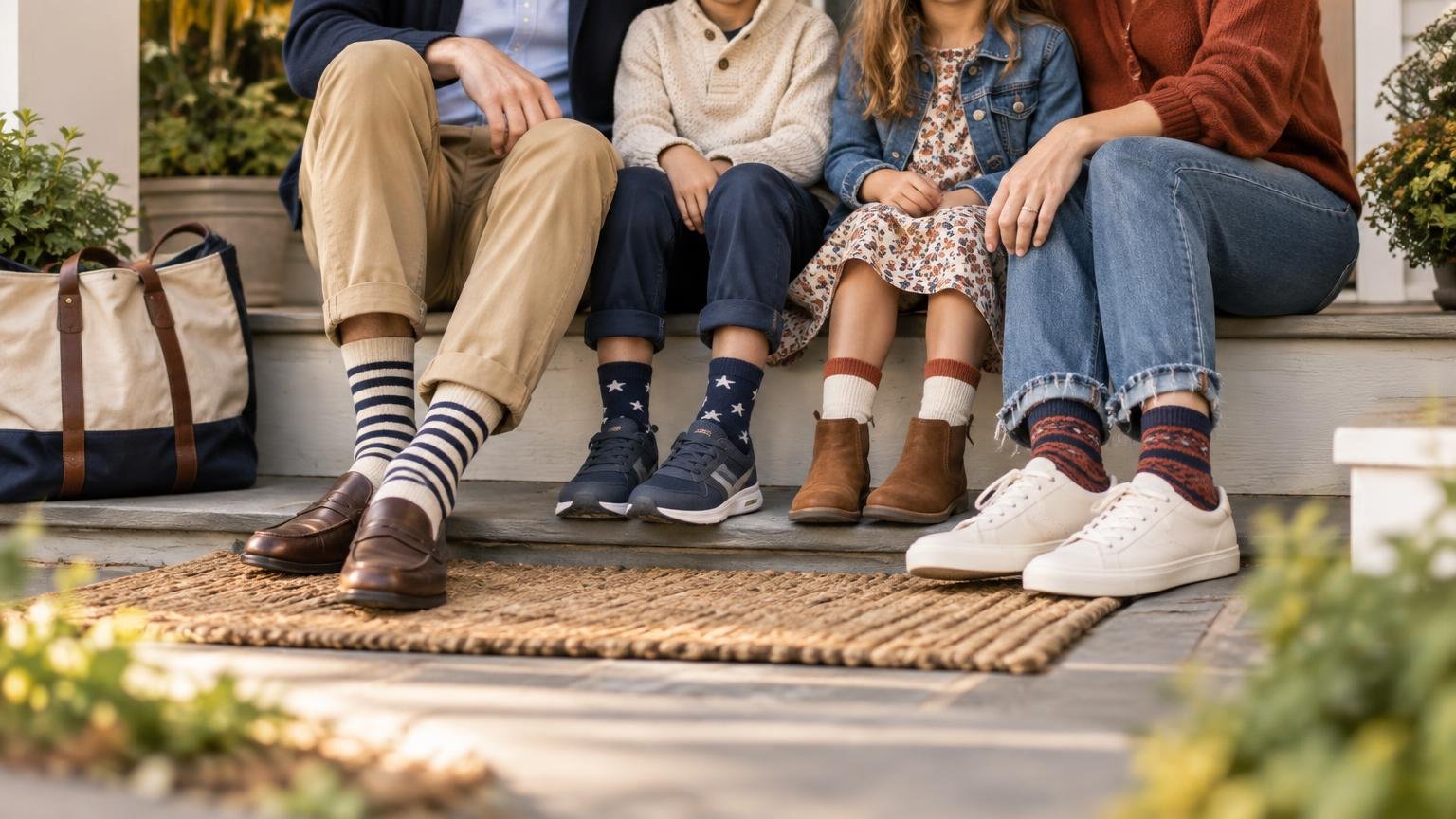
TLDR: The easiest way to choose matching family socks is to share one visual detail—such as a color palette, stripe, motif, or pattern family—without requiring every pair to be identical. Choose each person’s size, sock height, thickness, and material separately according to their shoes and plans.
A coordinated family look works best when it feels intentional rather than uniform. Matching family socks can provide that connection without asking everyone to wear the same outfit. They can be bold for a holiday photo, subtle for a wedding, or simply cheerful under jeans on a family trip.
Start with the occasion and decide how visible the socks should be. Then select one visual anchor for the group. Once that style decision is made, treat fit and comfort as individual choices rather than part of the matching requirement.
Choose how closely you want the socks to match
There are three useful levels of coordination. The right one depends on whether the socks are meant to lead the outfit, add a small shared detail, or create a playful photo moment.
| Matching level | What stays consistent | Best for |
|---|---|---|
| Identical | The same color, pattern, and general design | Holiday mornings, themed parties, playful family photos |
| Coordinated | A shared palette or motif, with different patterns or heights | Reunions, vacations, birthdays, and everyday family outfits |
| Subtle connection | One repeated accent color, stripe, or small symbol | Weddings, dressier events, and families who prefer understated styling |
Identical socks make the clearest visual statement, particularly when everyone is wearing pajamas or when the feet will be visible in a seated photo. This approach is less practical when the family spans babies, children, teenagers, and adults, because one design may not be offered in suitable sizes or constructions for everyone.
Coordinated socks are the most flexible choice. One person might wear navy crew socks with cream stars, another cream ankle socks with navy stripes, and a third a mostly solid navy pair. The shared palette creates the family connection even though each design is different.
A subtle connection works well for formal or semi-formal occasions. For example, wedding-party socks could repeat burgundy from the flowers or ties without giving every family member the same novelty print. The result looks deliberate but does not compete with the clothes.
Let the occasion set the mood
A useful matching theme should suit the event rather than exist separately from it. Bright illustrations and large motifs make sense for a festive pajama morning. A restrained stripe, small dot, or shared accent color is easier to integrate into reunion outfits or dressier celebrations.
Family photos
For a photo-first look, choose socks with enough contrast to register on camera. Red-and-cream crews stand out against neutral pajamas, while navy, forest green, or burgundy can connect casual outfits without making the image feel too busy. If shirts, sweaters, or pajamas already contain strong prints, use simpler socks in colors pulled from those prints.
Also consider the pose. Crew socks are useful when the family will sit on a sofa, gather on a bed, or pose without shoes. Ankle socks may disappear beneath trousers, while no-show socks will contribute little to a coordinated photograph.
Weddings and celebrations
For a wedding, anniversary, or milestone dinner, coordinate socks with an existing event color. One small shared detail is usually enough. Adults can wear dress socks while children wear comfortable crews in a related shade; the color creates unity even when the constructions differ.
Travel and active days
On a travel day, at a theme park, or during a long family outing, put comfort ahead of a perfect pattern match. Choose a common color or sporty stripe, then give each person the height and cushioning that works with their shoes. A coordinated palette will still read as a family detail without forcing someone to walk all day in an unsuitable pair.
Size every family member separately
Shared style does not mean shared sizing. Sock sizes may be linked to shoe sizes, and brands can publish separate ranges for adults and children. Smartwool, for example, provides distinct adult and children’s charts mapped to U.S., European, and U.K. shoe sizes. That is a useful reminder to check the chart for the particular maker rather than assuming that labels such as small, medium, and large translate across brands.
A sock should fit smoothly without excess fabric or uncomfortable tension. An oversized pair can wrinkle or bunch, while a pair that is too small may feel tight or slip out of position, according to REI’s sock selection guide. That matters for every wearer, but especially for children who may not explain clearly why a pair feels wrong.
- Write down each person’s current shoe size instead of estimating from age.
- Check whether the product uses shoe size, foot length, age, or a general apparel size.
- Look for separate baby, toddler, child, and adult ranges where needed.
- Do not size up automatically for a loose look; extra fabric can bunch inside shoes.
- If a wearer falls between sizes, follow the maker’s guidance and consider how stretchy or structured the sock appears.
For babies and toddlers, also inspect the product description for its intended age range and construction. A matching design is not useful if it cannot be purchased in an appropriate size. Product ranges and stock can change, so verify the current listing before planning an entire family set around one print.
Match sock height to each person’s shoes
Everyone can share a motif without sharing a sock height. In fact, using different heights often produces a more comfortable and wearable family set.
| Sock height | Works naturally with | Coordination tip |
|---|---|---|
| No-show | Low-profile casual shoes | Use when the family theme can appear elsewhere in the outfit |
| Ankle or quarter | Sneakers and casual walking shoes | Repeat a color at the cuff for a visible but restrained match |
| Crew | Boots, high-top shoes, pajamas, and photo outfits | Choose this when the pattern should be easy to see |
| Dress or taller socks | Trousers and dress shoes | Coordinate through color, a fine stripe, or a small motif |
These are flexible starting points, not rigid rules. The practical question is whether the sock sits comfortably with the footwear and whether the design remains visible enough for the intended effect. Sock height and cushioning should be considered alongside the shoes being worn.
A family might therefore use the same mountain motif on crew socks for a boot wearer, quarter socks for someone in running shoes, and a smaller child-friendly version for a toddler. The motif does the matching; the construction serves the person.
Choose thickness for the shoe, not the photograph
Thick, fuzzy socks look inviting in a gift box or pajama photo, but they can make snug footwear uncomfortably tight. Save bulky lounge socks for indoor use, roomy slippers, or boots that can accommodate them. For fitted sneakers and dress shoes, choose a lighter construction that will not crowd the toes or change how the shoe fits.
Cushioning and thickness are related, but they are not interchangeable with softness. A plush-feeling sock may still be poorly suited to a close-fitting shoe. Check the product’s cushioning description, consider the volume inside the shoe, and avoid treating one family-wide thickness as mandatory.
For a day involving plenty of walking, look for a secure fit and enough cushioning for the wearer’s shoes and preferences. For an evening at home, softness and visual appeal may matter more than technical performance.
Pick materials according to how the socks will be worn
Fiber content can help narrow the choice, but it does not predict the complete experience. Construction, thickness, fit, activity, and footwear all affect how a sock feels.
Merino wool, polyester, nylon, and stretch fibers can play different roles in moisture management, durability, shape retention, and fit. Textile Exchange also describes polyester as a durable, quick-drying synthetic fiber. These characteristics can be useful for travel or active use, but the exact blend and sock construction still matter.
- For indoor lounging: prioritize a comfortable feel, an easy fit, and a thickness that works with slippers or bare floors.
- For walking and travel: look for a secure shape, suitable cushioning, and materials intended to manage moisture and repeated wear.
- For dressier occasions: favor a smoother, lighter sock that fits comfortably inside the planned shoe.
- For a mixed-age gift set: check care instructions as well as fiber content, especially if easy family laundry is important.
If anyone has strong sensory preferences, let that guide the purchase. A coordinated color worn happily is better than an exact pattern that stays in the drawer because the cuff, seam, or texture feels irritating.
Easy matching family sock combinations
The simplest combinations begin with clothing the family already owns. There is no need to build every outfit around the socks.
- Holiday morning: red-and-cream crew socks with cream, gray, or red pajamas. Mix stripes, snowflakes, and mostly solid pairs within the same palette.
- Family reunion: navy and burgundy socks under jeans, chinos, or casual dresses. Let each person choose stripes, dots, or a small motif.
- Wedding: dress socks in one event color for adults, with soft crew or ankle socks in a closely related shade for children.
- Vacation: sporty quarter and crew socks sharing one bright stripe, selected separately for each traveler’s sneakers.
- Birthday gift: one favorite motif—such as animals, stars, or food—interpreted in different colors and heights for each family member.
- Parent-and-child pairing: the same two colors, with a bold pattern for the child and a quieter geometric design for the adult.
When coordinating several outfits, repeat no more than one or two obvious elements. If the socks share both a strong color and a large motif, keep the rest of the outfits relatively simple. If the clothing is already colorful, connect the socks through one quieter accent shade.
How to buy a family set without mistakes
Before ordering, make a short family checklist. This takes a few minutes and prevents the visual theme from pushing fit or practicality into the background.
- Name the occasion and decide whether the socks will be worn indoors, with shoes, or mainly for a photo.
- Pick one visual anchor: a palette, stripe, motif, or pattern family.
- List every wearer and record their current shoe size.
- Choose the best height and thickness for each person’s planned footwear.
- Check every size against the seller’s current chart rather than relying on a familiar size label.
- Confirm the fiber blend, care instructions, quantity, and included sizes for each listing.
- Review current stock and delivery timing before promising the set for a particular date.
If an exact family-wide print is unavailable in every needed size, switch to coordinated colors rather than buying poorly fitting substitutes. The family connection will still be visible, and the socks will be more useful after the event.
Common questions about matching family socks
Do family socks have to be identical?
No. A shared color palette, motif, stripe, or cuff detail is enough to make separate pairs look connected. Coordinated designs are usually easier to fit across ages and personal styles than one identical print.
What sock style is best for a family photo?
Crew socks are the easiest to show in seated poses, pajama photos, and pictures taken without shoes. If footwear will remain on, choose a height that shows above the shoe and use enough color contrast for the shared detail to be visible.
Should everyone wear the same sock height?
Not unless the height works with everyone’s shoes. Keep the color or motif consistent and adapt the height for sneakers, boots, dress shoes, or indoor wear.
Are matching socks a good family gift?
They can be an easy, practical group gift because each person receives an individual item while sharing in the theme. The strongest gift sets account for exact sizing, texture preferences, footwear, and how each recipient is likely to wear the socks.
Coordinate the look, personalize the fit
The best matching family socks share a visual idea without treating the family as a row of identical feet. Choose one recognizable connection, then adjust size, height, thickness, and material for each wearer. Start by listing everyone’s current shoe size and the shoes they will wear; once those practical details are settled, the fun pattern is much easier to choose.